Geometry & history 10 minute read
The Shape That Keeps Turning Up
How twenty-four heptagons became a meeting place for geometry, arithmetic, and an unusually human dispute over mathematical credit.
An illustrated essay · Four original mathematical figures
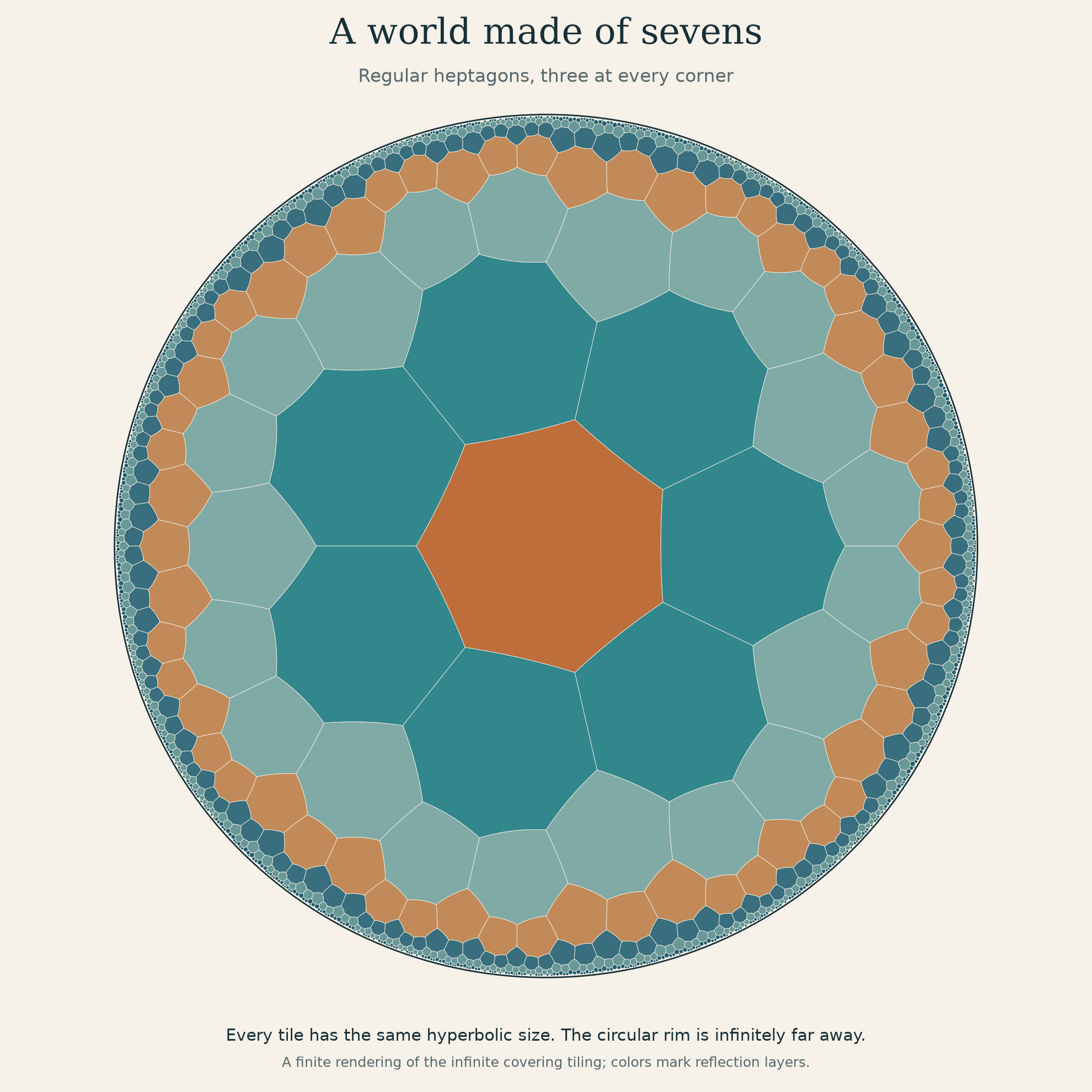
Imagine a world paved with identical seven-sided tiles. Three meet at every corner. You can walk indefinitely across this pavement, passing tiles as large as the ones you left behind. Yet on a map of the entire world, they seem to shrink toward a circular horizon, becoming impossibly fine before they disappear.
The map is telling the truth about angles and a carefully organized lie about size. Its horizon is infinitely far away.
This is the setting for the Klein quartic, one of those mathematical objects that seems to have more connections than its modest dimensions should permit. It is a surface with three handles, an equation of degree four, and an exceptionally symmetrical arrangement of polygons. It also supplies a route into a famous problem about seventh powers. These descriptions fit together precisely enough that a question asked in one language can sometimes be answered in another.
A world with more room
Try making this pavement with ordinary paper heptagons. Each interior angle of a regular heptagon is about 128.6 degrees. Three together exceed 360 degrees: they cannot lie flat around a point.
Hyperbolic geometry changes the arithmetic of space. Its triangles have less than 180 degrees in their angles, and its regular heptagons can have angles of exactly 120 degrees. Three then fit perfectly. The geometry has constant negative curvature, locally of the saddle-like kind. There is enough room for a pattern that the Euclidean plane refuses to accommodate. William Thurston’s explanation
The circular picture is the Poincaré disk model. Distances grow increasingly expensive near its rim. A short stroke there can represent a longer journey than a much larger stroke near the center. The shortest paths—geometry’s straight lines—usually appear as arcs of circles meeting the boundary at right angles. Paths through the center are ordinary diameters.
The model preserves angles, a property called conformality. A surveyor living in this world and a reader measuring the angles on the page would agree. They would disagree spectacularly about distances. Greg Egan’s geometric account
The distinction matters because the disk is a map of the infinite hyperbolic plane, while the Klein quartic is finite. To obtain the quartic, one imposes a particular system of identifications: many places on the infinite pavement are declared to represent the same place on the surface.
An ordinary torus offers the familiar rehearsal. Draw a square and identify opposite edges. Walking out through the right edge brings you back through the left. The infinitely repeated squares in the plane are copies of one square on the torus. For the Klein quartic, a more elaborate gluing pattern leaves twenty-four heptagons on a closed surface. The precise matching of edges is essential; a random collection of twenty-four tiles will not do. Klein’s original paper, in translation
We can audit the result with elementary bookkeeping. Twenty-four heptagons supply 168 sides, paired into 84 edges. Their 168 corners meet in threes, leaving 56 vertices. So
For a closed orientable surface, this number equals 2 − 2g, where g counts handles. Here g = 3: topologically, a doughnut with three handles. The infinite map repeats a finite world: twenty-four heptagons joined into a surface with three handles.
The maximum amount of order
The gluing preserves an extraordinary amount of freedom. Any heptagon can take the place of any other, and it can arrive in seven rotational positions. That gives
orientation-preserving symmetries. Allow transformations that reverse orientation, as a mirror does, and the total becomes 336. These are symmetries of the surface’s own geometry. A sculpture in ordinary space cannot display them all as rigid movements. Klein’s construction
The number 168 would already be impressive as a curiosity. It becomes more interesting as a limit. Hurwitz’s theorem says that a compact Riemann surface of genus g ≥ 2 has at most 84(g − 1) conformal, orientation-preserving symmetries. At genus three, the ceiling is 168. The Klein quartic reaches it. Most surfaces do not; attaining the bound is a special distinction, not an automatic consequence of having enough handles. A. Murray Macbeath on Hurwitz’s theorem
There is a small geometric engine behind that large number.
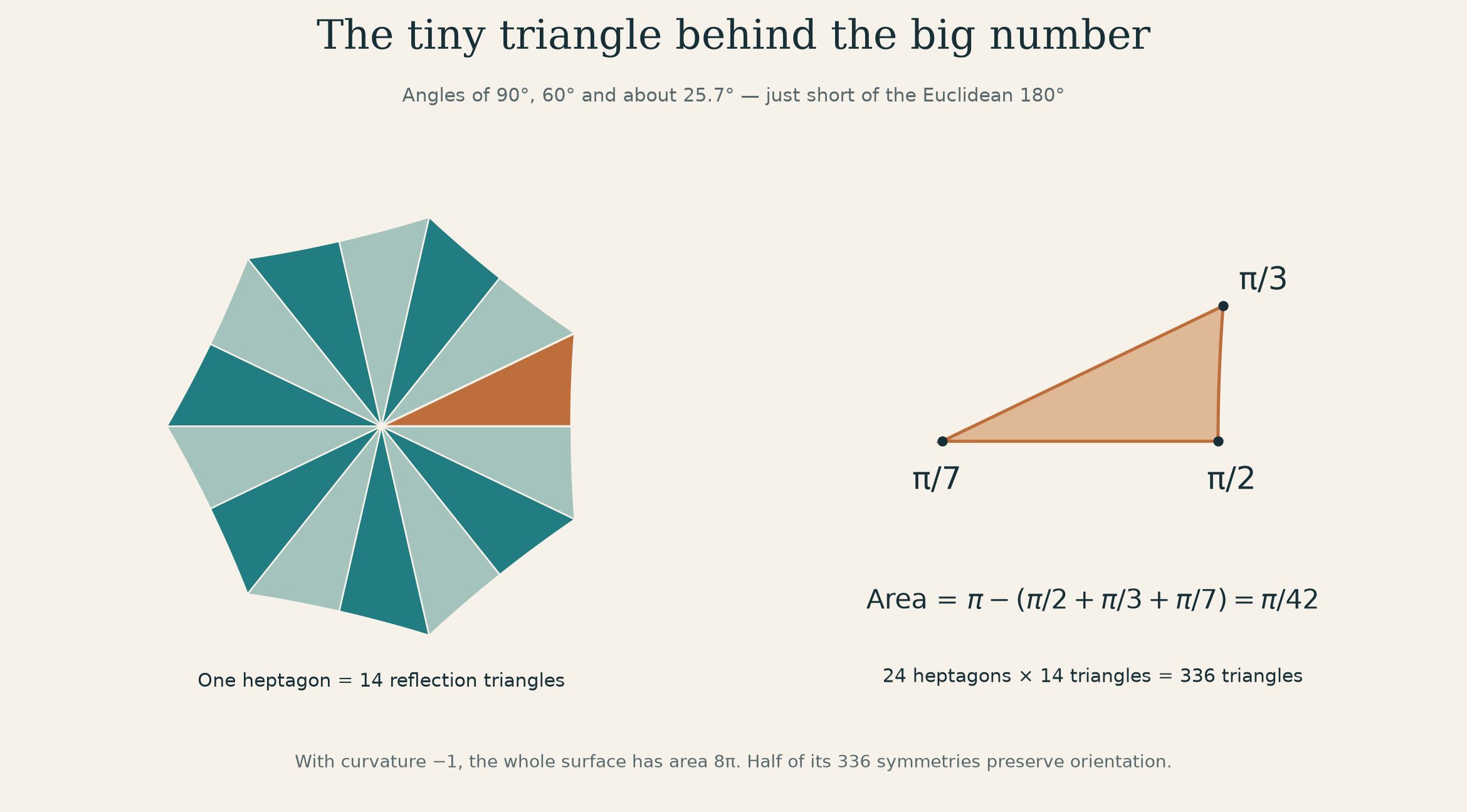
Those angles add to 41π/42, falling short of a Euclidean triangle by π/42. In hyperbolic geometry, with curvature normalized to −1, that shortfall is exactly the triangle’s area.
The entire three-handle surface has area 8π. Divide it by π/42, and 336 triangles fit. Half have each orientation, accounting for the 168 orientation-preserving symmetries. The same 2, 3, 7 triangle underlies the extremal case of Hurwitz’s theorem. Hermann Karcher and Matthias Weber’s geometric treatment
A useful intuition emerges: unusually small fundamental pieces allow an unusually large number of equivalent positions within a fixed total area. The abundance of symmetry has an economical explanation.
An equation wearing a surface
Klein published his great investigation in 1879. Its title concerned transformations of elliptic functions—a subject that sounds rather distant from a pavement of heptagons. His equation for the surface is unexpectedly compact:
Every term has total degree four, hence quartic. Cycling the letters leaves the equation unchanged: one symmetry is visible before any serious calculation begins. Klein’s paper
There is a qualification that popular illustrations sometimes hurry past. The variables are complex numbers, and the coordinates are projective: multiplying all three by the same nonzero number represents the same point. We are studying proportions, not an ordinary three-dimensional graph.
Locally, the equation leaves one complex degree of freedom. A complex number has two real components, so the resulting “curve” is a two-dimensional real surface. Add the points supplied by its projective setting, and it is compact. Algebraic geometers call it a curve; someone walking on it would experience a surface. Both descriptions are correct. Egan’s derivation from the equation
This is part of its practical value. The polygon picture makes its symmetries visible; the equation makes them available for calculation. Moving between the two is substantial mathematics, but the result is an object one can approach with different sets of tools.
Seven points, and a familiar number
The quartic’s symmetry group also governs a tiny geometry called the Fano plane: seven points and seven lines, with three points on every line.
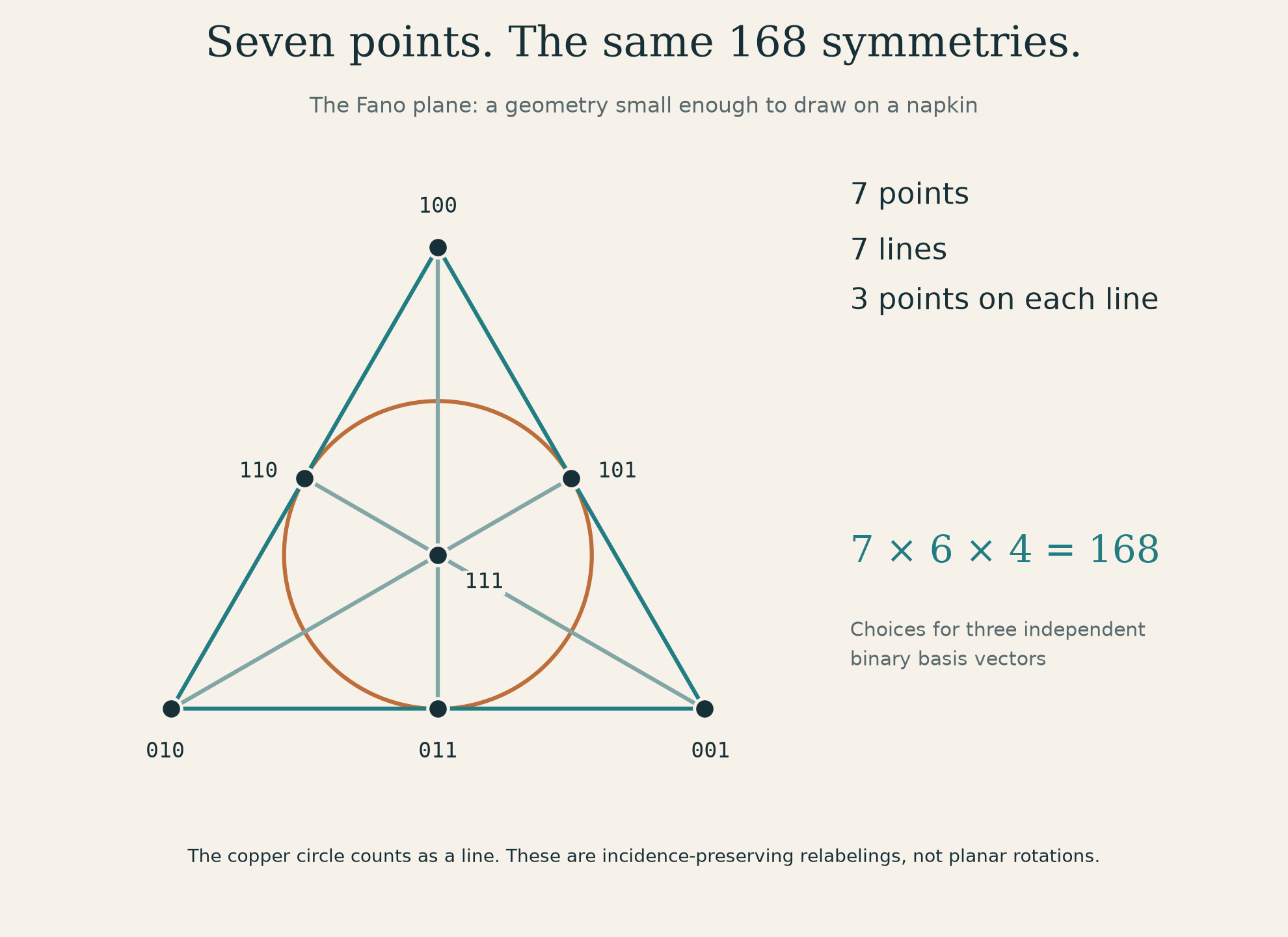
There are exactly 168 such rearrangements. More strongly, their composition follows the same rules as the quartic’s orientation-preserving symmetries: the groups are isomorphic. The matching number is a consequence of matching structure. John Baez’s account of the connection
The binary labels let us count them. Choose where three independent coordinate vectors go. There are seven choices for the first, six for the second, and four for the third, which must lie outside the plane spanned by the first two. Thus 7 × 6 × 4 = 168.
A continuous surface and a seven-point geometry have the same algebra of motions. This gives finite, combinatorial ways to study an object whose points are complex numbers—one reason the quartic keeps appearing at the borders between subjects.
Whose disk is it, anyway?
The history is less tidy than the pictures. Even the label “Poincaré disk” compresses several distinct achievements into one surname.
Lobachevsky and Bolyai developed hyperbolic geometry in the nineteenth century. Beltrami then supplied concrete models in papers of 1868–69, showing how its apparently alien rules could be realized and studied within familiar mathematics. His work included the conformal disk; Riemann had already indicated its metric in his earlier lecture on geometry, published posthumously. Klein developed the projective interpretation of another model, now often called the Beltrami–Klein disk. Nicola Arcozzi’s study of Beltrami’s papers
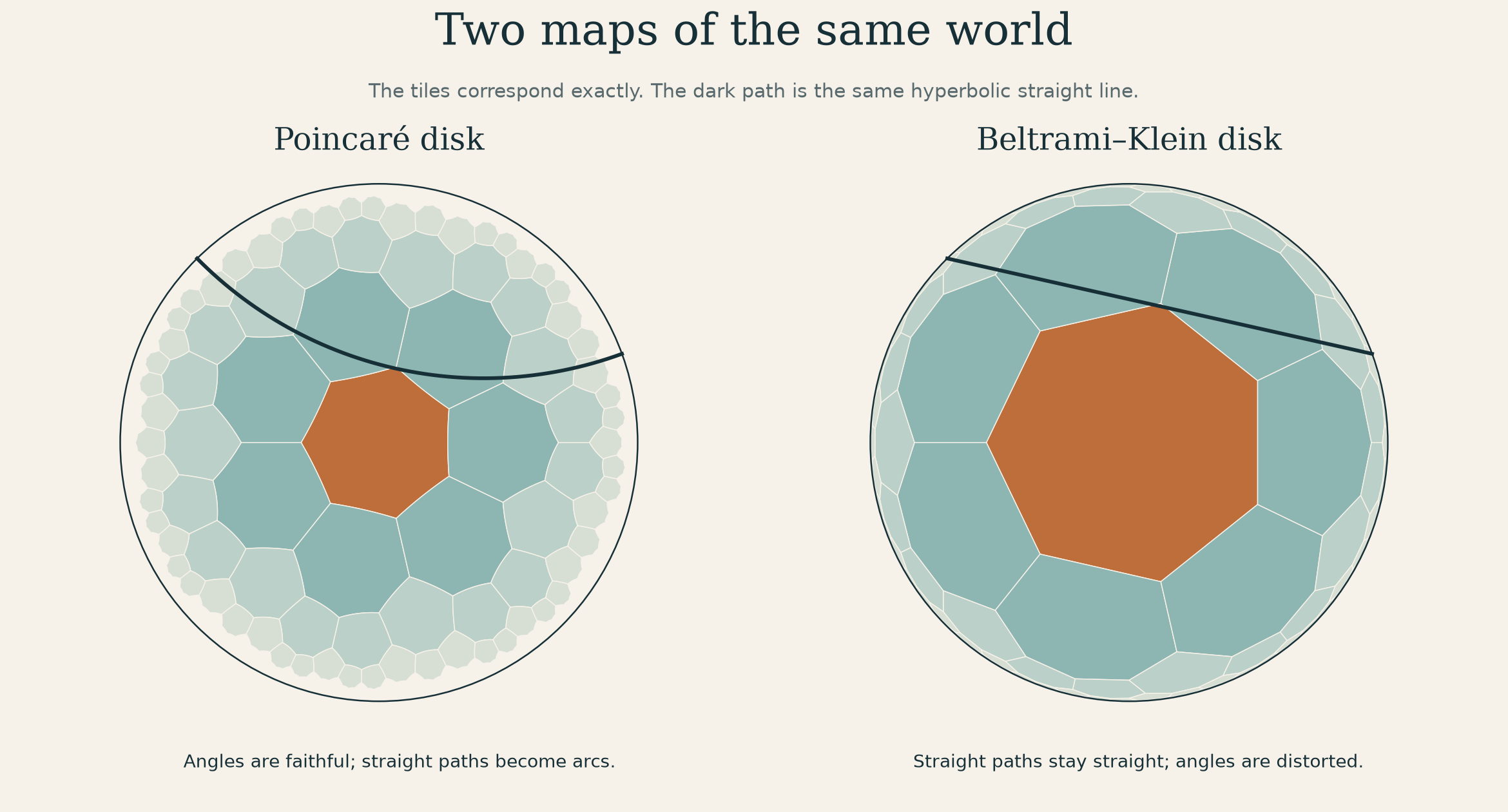
There were sophisticated circular-arc tessellations before Poincaré’s breakthrough. Schwarz produced one in the early 1870s without recognizing it as a picture of non-Euclidean geometry. Having the diagram and understanding what it could explain were different stages of discovery.
Around 1880, Poincaré made hyperbolic geometry central to his work on differential equations and complex functions. Transformations arising in analysis could be understood as motions of a geometric world. That recognition helped him organize groups, construct functions, and prove results about their convergence. The disk became a place where difficult analysis acquired geometric structure. Jeremy Gray and Scott Walter’s historical commentary
It is therefore reasonable to object to a history in which Poincaré simply invents the model. It is equally inadequate to treat his contribution as attaching a famous name to an existing picture. His synthesis changed its mathematical role.
The participants themselves were quite alert to credit. In June 1881, Klein wrote to Poincaré: “I reject the name ‘Fuchsian functions’”—arguing that the intellectual foundations lay elsewhere, especially with Riemann and Schwarz. This was a dispute about the ancestry of a new function theory, rather than the later name of the disk, but it reveals how actively the historical account was being negotiated. Klein’s letter of June 19, 1881
A mathematical name is often a memorial to an influential use. It makes an unreliable deed of ownership.
What the beauty buys
The quartic’s connections lead to concrete results. It is also the compactified modular curve X(7), which organizes elliptic curves equipped with suitable information about their points of order seven. Roughly, it is a surface whose points describe other mathematical shapes, together with extra markings.
An especially satisfying application concerns Fermat’s equation for seventh powers. Suppose
Set x = A³C, y = B³A, and z = C³B. Direct multiplication gives
A proposed solution to Fermat’s equation lands on the Klein quartic.
The hard arithmetic step is proving that this quartic has only three rational projective points: the coordinate points (1:0:0), (0:1:0), and (0:0:1). That leaves no room for a solution with all three of A, B, C nonzero. The route proves the exponent-seven case of Fermat’s Last Theorem. Noam Elkies’s number-theoretic treatment, §§3.1–3.2 and 4
Here the movement between subjects does real work. A question about whole numbers is transferred to a surface; the surface imposes a restriction; the restriction returns as an impossibility for the original equation.
In 1993, Helaman Ferguson’s sculpture The Eightfold Way was unveiled at Berkeley’s Mathematical Sciences Research Institute. Its carved surface and tiled base brought these different views into one physical object. Silvio Levy’s account of the commission
The title refers to a pleasing navigational rule on the quartic’s heptagon network: follow an edge and alternate left and right turns. After eight turns, you return to where you began. Thurston’s inauguration essay
That makes an apt way to leave the subject. Follow geometry into algebra, algebra into arithmetic, arithmetic back into geometry, and a familiar shape appears again. The Klein quartic is beautiful to look at. Its deeper appeal is that it rewards the journey around it.
Four original mathematical figures, constructed from exact disk geodesics and the incidence structure of the Fano plane.