Escher & perception 5 minute read
Angels, Devils, and the Shape Between Them
Circle Limit IV turns empty space into a second population—and lets a small imperfection in symmetry carry an enormous idea.
An illustrated essay · 1 figure
Look at an angel. Follow a wing outward, past the feathers, to the dark space beside it. Keep looking at that space until it acquires a body of its own. The angel has not moved, but the picture has changed. What appeared to surround one creature now belongs to another.
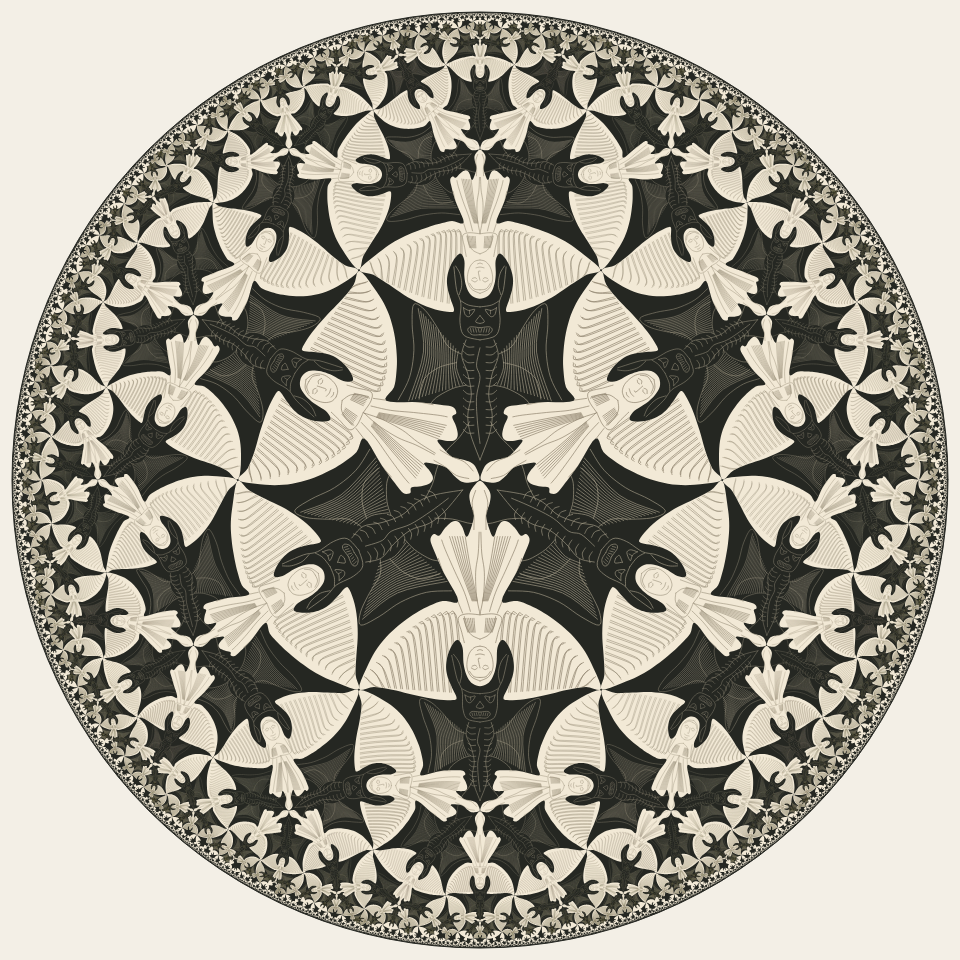
This is the first bargain offered by M. C. Escher's Circle Limit IV: every figure must share its outline with a figure of the opposite kind. The white population cannot spread without making the black population change shape. There is no neutral background into which either side can retreat.
Completed in July 1960, the woodcut is also called Heaven and Hell. Its creatures had a previous life in Escher's planar Regular Division drawing no. 45, from 1941. The later disk places their relationship inside a world whose apparent edge can never be reached. The museum's account provides the print and its earlier drawing side by side.
A boundary with two owners
Ordinary drawing often begins by separating an object from its surroundings. A line says: the bird ends here; the sky begins there. Escher makes that line answerable to both sides. One subject's contour has to perform a second anatomical job.
Try outlining a convincing wing. That is already a design problem. Now require the space alongside the wing to become part of a convincing body, and require both figures to fit their next neighbors. A successful local decision has consequences several steps away. This is why the result feels richer than a shape stamped repeatedly across a page. The individual figures have negotiated a common border.
Their dependence is visual before it is theological. The title invites us to think about opposites, but the geometry does not establish a doctrine about good and evil. It establishes something more specific: two populations can define one another without becoming interchangeable. The moral reading is an interpretation of that arrangement, not a theorem concealed inside it.
That distinction leaves the picture open. It can be read as conflict, balance, entanglement, or the difficulty of imagining one pole of an opposition without its partner. The drawing is unusually hospitable to those thoughts because their underlying relation is genuinely visible.
What the rim is doing
The creatures appear to shrink as they approach the circular boundary. In the ideal hyperbolic pattern, however, their intrinsic size remains constant. The Poincaré disk is a map with a changing scale: distances near the edge require progressively more geometry per millimeter of paper.
Imagine walking outward with a ruler that belongs to the world in the picture. Each time you cross another figure, you would find the ruler still appropriate to its size. From outside the picture, both the figure and your ruler would look smaller. Nothing you experience locally has become miniature.
The distinction separates this pattern from a spiral of shrinking ornaments. An artist can make shapes smaller by any chosen ratio. Here their changing appearance follows the rules of a homogeneous geometry. The center is privileged by the map, not by the space it represents. A different point could be brought to the center, with the surrounding world rearranging coherently.
There is nevertheless a real ending in the physical object. Wood, ink, paper, eyesight, and pixels all have limits. No print contains infinitely many individually resolved creatures. The finite marks give us enough of a rule to understand how the pattern could continue. Its infinity is intelligible without being literally manufactured.
Less symmetry, more expression
One of the print's best details is easy to miss when it is introduced as an illustration of mathematical symmetry. Escher does not give every creature equal descriptive attention. Some receive interior linework; some recede into background; others occupy an intermediate state.
Douglas Dunham's analysis distinguishes the symmetry of the outlines from the symmetry of the finished treatment. Ignoring the signature and date, the detailed composition retains three reflection axes and rotations by 120 degrees: six symmetries altogether. The underlying outline pattern permits many more. Including the unique inscription would reduce the exact symmetries further. Dunham, The Symmetry of Circle Limit IV and Related Patterns
The practical consequence is striking. Imagine a computer faithfully repeating every engraved detail wherever the same outline occurs. It could become more regular while becoming less like this particular work of art. More symmetry would not constitute a more complete reconstruction of Escher's intention.
There are two different achievements here. The outline gives the figures a world they can inhabit indefinitely. The distribution of detail gives the viewer a composition to read now. One provides continuity; the other directs attention. The print needs both.
A world rather than a puzzle
Circle Limit III rewards scrutiny of its fish, colors, and flowing paths. IV asks for a different kind of attention. Its stark opposition and enormous implied extent make the disk feel like an entire order of things. That is why IV's grand perspective can remain compelling even after the initial figure–ground surprise has worn off.
The eye moves outward, expecting the multitude eventually to stop. Instead, the drawing keeps supplying reasons for continuation. It moves inward, looking for a sovereign figure, and finds several creatures holding the center together. It changes its allegiance from white to black and discovers that the apparent background was occupied all along.
To explore the pattern, begin with the silhouettes in the interactive reconstruction. Follow one shared edge before moving the view. Then restore the detail and notice how much of recognition comes from a few internal marks. Finally, return to Escher's original and look for the unequal emphasis that the fully detailed reconstruction smooths away.
The achievement is not merely that two shapes fit. It is that fitting becomes a way of thinking: about attention, opposition, and a world in which neither side gets to exist alone.